

TB-002: HP Z2 G4/G5 Rear Cooling & Thermal Validation Part 2
Comparative Evaluation of Rear Exhaust Fan Configurations in HP Z2 G4 and G5 Small Form Factor Workstations
Document Number: TB-002
Revision: A
Release Date: June 21, 2026
Abstract
CleanSpec Lab Tech Brief-001 demonstrated that restoring rear chassis airflow to HP Z2 Small Form Factor workstations lacking a factory rear exhaust fan significantly improves CPU thermal performance during sustained computational workloads.
Following publication of TB-001, additional testing was conducted to compare multiple rear exhaust fan configurations using identical test methodology. This study evaluates four configurations:
No rear chassis fan
HP OEM rear chassis fan
CleanSpec Lab CSL-001/002 with Noctua 60 mm PWM fan
CleanSpec Lab CSL-001/002 with Delta 60 mm PWM fan
Testing was performed on representative HP Z2 G4 and HP Z2 G5 systems using OCCT CPU Stability Testing under identical software configuration and environmental conditions.
The objective was not to identify the single "best" fan, but rather to determine whether the CleanSpec Lab rear fan solution restores cooling performance comparable to factory hardware.
Background
HP designed the Z2 G4 and G5 Small Form Factor workstations to operate with directed front-to-rear airflow.
Many refurbished systems are sold without the optional rear exhaust fan assembly because:
the OEM bracket is difficult to source,
replacement parts are expensive,
many systems were originally configured without one.
TB-001 demonstrated that installing a rear exhaust fan substantially reduced processor temperatures.
This follow-up investigation expands the available data by comparing multiple fan implementations.
Test Equipment
HP Z2 G5 SFF
Processor:
Intel Xeon W-1250
CPU Cooler:
HP 125 W Performance Cooler
Configurations Tested:
No Rear Fan
CSL-001 with Noctua PWM Fan
CSL-001 with Delta PWM Fan
HP Z2 G4 SFF
Processor:
Intel Xeon E-2146G
CPU Cooler:
Factory HP Cooler
Configurations Tested:
No Rear Fan
HP OEM Rear Fan
CSL-002 with Noctua PWM Fan
CSL-002 with Delta PWM Fan
Test Methodology
Each configuration completed an identical OCCT CPU Stability test using:
CPU Test
Extreme Mode
Variable Load
AVX2
10-minute duration
For each configuration, the following metrics were recorded:
Average CPU Package Temperature
Maximum CPU Package Temperature
Successful completion without computational errors
No hardware changes other than the rear exhaust fan configuration were made between tests.
Results
HP Z2 G5
Observations
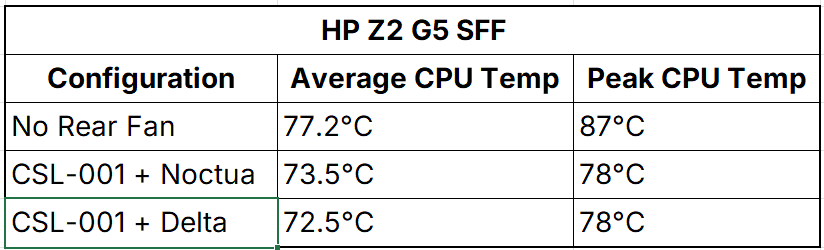
Adding a rear exhaust fan reduced peak processor temperature by approximately 9°C compared to operation without a rear fan.
Temperature differences between the Noctua and Delta configurations were approximately 1.0°C, well within the range expected for repeated thermal testing.
No computational errors were observed during any test.
HP Z2 G4
Observations
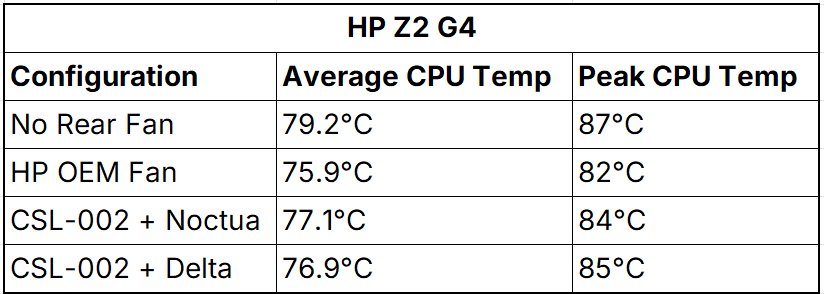
The factory HP rear fan produced the lowest observed processor temperatures.
Both CleanSpec Lab configurations significantly improved cooling compared to operating without a rear exhaust fan.
Differences between the OEM, Noctua, and Delta configurations remained relatively small compared to the improvement realized by restoring rear airflow.
Discussion
The results suggest that rear airflow is substantially more important than the specific fan selected.
Across both workstation generations, the presence of a properly functioning rear exhaust fan consistently reduced sustained processor temperatures.
The G5 exhibited the largest improvement, suggesting that its thermal architecture relies more heavily on rear exhaust airflow. This observation suggests that the G5 thermal design is more sensitive to rear exhaust airflow than the G4 under the configurations evaluated.
The G4 also benefited from additional airflow, although improvements were smaller. This likely reflects differences in heatsink design and airflow characteristics between generations.
The testing further indicates that premium high-speed industrial fans do not necessarily provide measurable thermal advantages over quality consumer PWM fans in these configurations.
Engineering Assessment
Based on the available data, the CleanSpec Lab CSL-001 and CSL-002 rear fan mounting systems successfully restore rear exhaust capability to HP Z2 workstations.
Under the test conditions evaluated, thermal performance was comparable to the factory HP rear fan assembly.
For refurbishment applications, restoring the intended airflow path appears to be substantially more important than maximizing airflow with higher-performance fans.
Limitations
This investigation was intentionally performed as an applied engineering validation rather than a formal laboratory study.
The following limitations should be considered when interpreting the results:
Testing was performed using one representative HP Z2 G4 and one representative HP Z2 G5 workstation.
Ambient temperature was not actively controlled, although testing was performed under similar environmental conditions.
Only the processor and cooler combinations identified in this report were evaluated.
Individual systems may exhibit different thermal behavior due to manufacturing variation, heatsink condition, thermal interface material application, firmware revisions, fan tolerances, or accumulated dust.
Despite these limitations, the methodology is appropriate for its intended purpose.
Each configuration was tested using identical software, hardware, workload, and procedures while changing only the rear fan configuration. This controlled approach isolates the effect of rear exhaust airflow and provides practical engineering evidence suitable for refurbishment validation and product development.
As additional HP Z2 systems are processed through CleanSpec Lab, future testing will expand this dataset and may be incorporated into subsequent technical publications.
Conclusions
This investigation reinforces the conclusions presented in Tech Brief-001.
Key findings include:
Rear exhaust airflow measurably improves sustained CPU cooling.
Operating without a rear chassis fan consistently produced the highest temperatures.
Within the scope of testing performed, CleanSpec Lab CSL-001 and CSL-002 restored thermal performance to a level comparable to the factory HP rear exhaust solution.
Differences between Noctua and Delta fan configurations were minimal under the conditions evaluated.
For refurbished HP Z2 systems, restoring the intended airflow path is more significant than selecting a higher-performance fan.
Future Work
Future work will expand testing to additional HP Z2 G4 and G5 configurations, evaluate other processor and heatsink combinations, and investigate long-duration thermal stability under mixed CPU/GPU workloads.
References
TB-001
HP Z2 G4/G5 Rear Cooling & Thermal Validation
OCCT Version 16.1.10
CleanSpec Lab Internal Thermal Validation Data
