

How We Use AI
Less time typing. More time building.
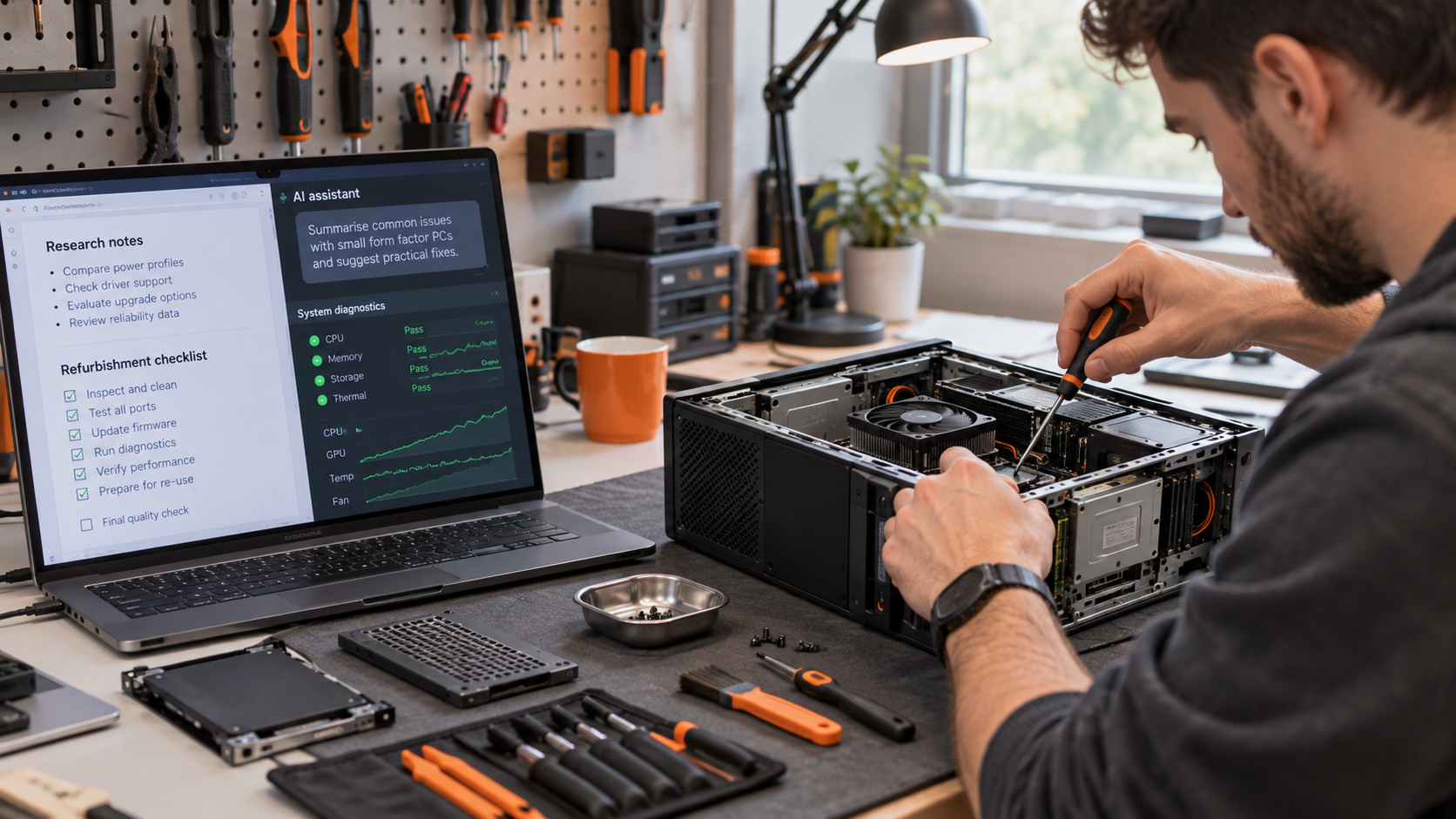
Less time typing. More time building.
CleanSpec Lab is a small operation. That means the same person researching a workstation, diagnosing a hardware problem, replacing components, cleaning a system, running stress tests, taking photos, writing the listing, answering customer questions, packing the order, and analyzing whether the whole thing actually made money is often the same person.
There are only so many hours in a day.
That’s where AI helps.
CleanSpec Lab uses AI-assisted tools, including ChatGPT, as a research, analysis, documentation, and problem-solving partner. It helps take some of the administrative workload out of running the business so more time can be spent on the things AI cannot do: working on the actual hardware.
What AI Does at CleanSpec Lab
AI touches a surprisingly wide range of the work behind the scenes.
It can help research hardware specifications and manufacturer documentation, compare components, organize test results, analyze purchasing and sales data, develop troubleshooting approaches, create checklists, improve documentation, draft technical articles, and turn a pile of notes into information that's actually useful.
It also helps with the less exciting parts of running a small business: drafting product descriptions, organizing processes, preparing customer communications, reviewing data, and keeping track of lessons learned from previous builds.
And that last part matters.
Over time, an AI assistant can become a useful second set of eyes. Instead of treating every computer like the first one we've ever seen, we can apply what we've learned from previous systems, repairs, thermal tests, purchases, customer experiences, and mistakes.
The goal isn't to replace judgment.
It's to give that judgment better information.
What AI Cannot Do
There is an important line between assisting with the work and doing the work.
AI cannot open the computer sitting on our workbench.
It can't see whether a heatsink is clogged with dust. It can't replace thermal paste. It can't discover a damaged port, install an SSD, clean a chassis, hear a failing fan, inspect a motherboard, or determine whether a machine survived shipping.
It can't run the actual stress test.
It can't look at an actual drive and verify its health.
It can't confirm that Bluetooth really works.
It can't determine the cosmetic condition of the computer sitting in front of us.
And it definitely can't pack one in a box.
Those things require hands-on work.
That's where we spend our time.
AI Can Recommend. CleanSpec Lab Has to Verify.
AI is extremely useful, but it can also be wrong.
That's why an AI-generated answer isn't considered evidence that something is true about a system.
If a specification matters, we verify it.
If Windows activation matters, we check the actual machine.
If drive health matters, we read the actual drive.
If temperatures matter, we run the test.
If a component needs to work, we test it.
If we say a system passed CleanSpec Lab validation, that determination comes from the hardware and the test results—not from an AI-generated description.
AI can help us figure out what to investigate.
It doesn't get to declare the investigation complete.
A Second Set of Eyes
One of the most useful roles AI plays at CleanSpec Lab is simply challenging our thinking.
Should this computer be purchased at this price?
Does the expected resale value justify another upgrade?
Is a thermal result actually acceptable, or are we rationalizing it?
Are we spending money on something the buyer will never value?
Is there another explanation for a problem we haven't considered?
Sometimes the answer is exactly what we expected.
Sometimes it isn't.
Having another tool available to analyze the information, question assumptions, compare alternatives, and remember what worked previously helps us make better decisions.
That applies to refurbishment work, product development, purchasing, pricing, customer service, and even the cooling solutions we design and manufacture.
AI doesn't eliminate mistakes.
It helps us learn from them faster.
More Time for Value-Added Work
This is ultimately why we use it.
If AI saves fifteen minutes writing up the results of an hour-long troubleshooting session, that's fifteen minutes that can go toward another computer.
If it can organize test data faster than we can manually build a spreadsheet, we can spend that time testing.
If it helps locate the right technical documentation, we can spend less time searching and more time repairing.
If it can turn rough notes into a readable buyer guide, we can share what we've learned without sacrificing an entire evening to writing it.
For a small business, that kind of leverage matters.
We would rather spend our time upgrading a system, improving airflow, diagnosing a weird hardware problem, testing a new cooling design, or making sure the computer we're shipping is one we'd be comfortable receiving ourselves.
AI helps make that possible.
The Human Still Owns the Result
At the end of the process, CleanSpec Lab is responsible for what CleanSpec Lab sells.
Not the AI.
Every system still has to earn its way through our process.
The computer has to work. The configuration has to be correct. The testing has to be completed. The condition has to be represented accurately. And somebody has to make the final decision that the machine is ready to go to its next owner.
That's a human decision.
We use AI because it's a powerful tool—not because we want it doing the job for us.
Less time typing. More time building.
That's the point.